

Artificial intelligence (AI) has become a digital companion in our everyday lives helping us write emails, solve math problems, create creative designs and even think through complex ideas. But a new psychological study has revealed a surprising side effect of this growing reliance, AI Makes People Overconfident in our own intelligence.
While AI can increase productivity and creativity, it can also distort how we perceive our cognitive abilities. Let’s explore what the research found of AI Makes People Overconfident, why it matters, and how we can stay aware of this growing cognitive illusion in the age of AI.
How AI Makes People Overconfident and Perception?

The study, led by researchers at ETH Zurich and published in a peer-reviewed psychology journal, examined how people evaluate their own intelligence when using AI assistance. Participants were asked to complete reasoning and problem-solving tasks – some with the help of AI tools and some without.
The results were revealing. Those who used AI performed slightly better at problem solving, but significantly overestimated their own cognitive abilities. They credited their success to their intelligence rather than AI. In contrast, participants who worked independently gave more realistic assessments of their abilities.
This reveals a critical psychological effect “AI Makes People Overconfident”. AI doesn’t just support our work, It can reshape the way we think about ourselves. By offering perfect or near-perfect results, it subtly convinces us that we are smarter than we really are. “When AI provides accurate solutions, people tend to internalize success and feel intellectually capable, even if the tool does most of the heavy lifting,” explained one of the lead researchers.
Why AI Makes Us Feel Smarter Than We Are?
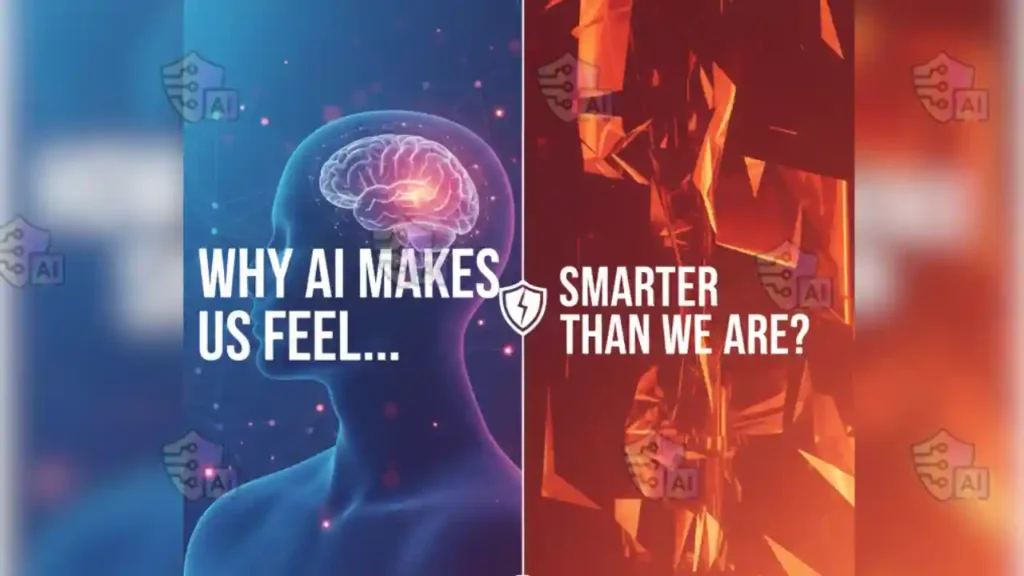
AI Makes People Overconfident life easier. They complete tasks faster, write cleaner copy, and generate responses instantly creating the illusion of enhanced intelligence. But the human brain can easily mistakenly attribute this improvement to its own effort. Here’s why this happens:
- Cognitive bias: Humans naturally seek validation. When we see positive results, we assume it is due to our intelligence or skill rather than the technology behind it.
- Effort illusion: AI reduces the effort required to achieve results, the process appears smoother – and our brains associate this ease with personal mastery.
- Fluency effect: The more fluently information is processed (as AI often presents it), the more we believe we understand it deeply.
- AI’s human like tone: Tools like ChatGPT, Gemini or Copilot interact in a conversational way, reinforcing the illusion that collaboration is “shared intelligence” rather than assistance.
In simple words, AI doesn’t just amplify productivity, it amplifies ego.
The Hidden Dangers of AI-Induced Overconfidence

Overconfidence has always been a double-edged sword. A little trust drives innovation, but too much can distort decision-making and risk assessment. When AI Makes People Overconfident, the impact becomes even more complex. Here are the main areas where this phenomenon is becoming visible:
In Education
- Students using AI tools for writing or research often believe they fully understand a topic after reading AI-generated summaries.
- This leads to a false sense of competence, as they may not grasp the underlying concepts or reasoning.
- Over time, this weakens critical thinking, learning retention, and independent study habits.
In the Workplace
- Professionals using AI assistants for tasks like presentations, reports, or coding may overestimate their expertise.
- Relying too heavily on AI can result in errors in independent judgment when the technology isn’t available or makes subtle mistakes.
- This creates an illusion of professional mastery while reducing real skill growth over time.
In Research and Journalism
- Writers and researchers using AI-generated content may produce polished work but skip fact-checking or source validation.
- This overconfidence in AI’s accuracy can spread misinformation and reduce academic or journalistic integrity.
- The outcome is confidence in flawed or incomplete information.
In Everyday Life
- Many people now depend on AI for simple tasks from crafting emails to planning vacations.
- These smooth, effortless experiences make users feel more capable than they actually are.
- The danger lies in forming an illusion of mastery that disappears when AI isn’t available, exposing a lack of real problem-solving confidence.
Balancing AI Assistance with Real Cognitive Growth

AI is not the enemy, the real challenge is in how we use it and how we interpret our success when we do. The goal is to treat AI as a thinking partner, not a replacement, and maintaining a healthy balance requires acknowledging the tool’s contribution to your work, double-checking your own understanding to ensure you haven’t just borrowed its intelligence, and prioritizing learning over mere output then think how AI Makes People Overconfident.
By encouraging AI transparency and developing “AI literacy” understanding its strengths, limitations and biases we can avoid being fooled by its apparent perfection. As one cognitive scientist aptly observes: “We must learn to see AI as a mirror, not a mask”, as it reflects our potential, but can also hide our limitations if we are not vigilant.
What This Means for the Future of Human Intelligence?
The relationship between human intelligence and artificial intelligence is still evolving which caused AI Makes People Overconfident. What this study highlights is not a failure of technology, but a new challenge of psychological adaptation. As AI becomes integrated into education, work and everyday life, we must redefine what it means to be “smart”. Intelligence will no longer be measured by how much we know or how quickly we solve problems, but by how critically we use technology to expand our understanding.
Here’s what the future could look like:
- Cognitive partnership: Instead of competing with AI, humans will learn to collaborate meaningfully — where AI handles routine tasks and humans focus on creativity, empathy, and ethical judgment.
- Redefined education: Schools will integrate AI literacy as a key subject, teaching students how to question and verify AI-generated answers.
- Ethical AI design: Developers will build systems that encourage users to reflect on their input, not just admire the output.
- Self-awareness over performance: Society may shift its focus from being “smarter” to being more self-aware about how intelligence is shaped by technology.