
Artificial Intelligence continues to redefine the way we create, design and visualize ideas. Now, Microsoft is taking another bold step with the launch of its first in-house AI image generator, officially called MAI-Image-1 by Microsoft Launches MAI-Image-1. This innovative tool allows users to create detailed, realistic and imaginative images directly from simple text instructions marking an important milestone in Microsoft’s growing generative AI ecosystem. Microsoft has officially entered the competitive AI imaging arena with the launch of MAI-Image-1, a powerful new tool designed to challenge established leaders. The introduction of MAI-Image-1 represents Microsoft’s strategic move to leverage its AI research into practical creative applications. Built on an advanced proprietary architecture, Microsoft Launches MAI-Image-1 promises highly detailed photorealistic images from simple text prompts, with a particular focus on visual accuracy and coherence. The implementation of MAI-Image-1 deepens the integration of Microsoft’s generative AI across its ecosystem, positioning it as a secure, enterprise-grade solution. Although currently in limited access preview, this release of Microsoft Launches MAI-Image-1 signals Microsoft’s strong ambition to become a dominant force in visual AI, offering creators and businesses a new and reliable option for imaging. What Is Microsoft Launches MAI-Image-1? MAI-Image-1 (short for Microsoft Artificial Intelligence Image 1) is the company’s first in-house developed AI image generator, designed to rival popular tools like DALL·E, Midjourney, and Adobe Firefly. Unlike Microsoft’s previous integrations with OpenAI models, MAI-Image-1 represents an independent effort – designed and trained by Microsoft’s own AI research division. The model is capable of generating high-quality images, illustrations, and concept art from natural language descriptions. The goal behind MAI-Image-1 is simple yet powerful: To make creative image generation faster, smarter, and more accessible directly within Microsoft’s ecosystem. This means users could soon generate AI art right inside Microsoft 365, Edge browser, or even Windows Copilot, without needing any third-party service. How MAI-Image-1 Works? Basically, Microsoft Launches MAI-Image-1 operates on advanced text-to-image diffusion models trained on vast open-source and licensed image datasets. When you type a description like “futuristic city skyline at sunset in watercolor style,” the AI interprets your words, understands the context, and produces a detailed, realistic image that matches your intent. Key technologies powering MAI-Image-1 include: How to Use MAI-Image-1? Getting started with MAI-Image-1 is simple. Microsoft plans to make it available through its major platforms including Microsoft Edge, Copilot, and Microsoft Designer. Here’s how you can use it: Step 1: Access the Tool Step 2: Enter Your Prompt Type a descriptive text prompt such as: “A minimalist logo of a mountain with sunrise in gradient colors.” Step 3: Customize the Output You can choose: Step 4: Generate & Edit Click “Create” the AI generates multiple versions. You can refine or edit using built-in tools for background removal, color adjustment, and upscaling. Step 5: Download or Use in Microsoft Apps Once done, you can: Comparison: MAI-Image-1 vs Other AI Image Generators Feature MAI-Image-1 (Microsoft) DALL·E 3 Midjourney Adobe Firefly Developer Microsoft OpenAI Midjourney Inc. Adobe Integration Microsoft 365, Edge, Designer ChatGPT, Bing Discord Adobe Creative Cloud Style Options Wide, controllable via prompt Limited presets Artistic, detailed Photorealistic Privacy High (in-house) Moderate Moderate High Image Quality 4K+ 2K 4K 2K Cost Likely free for Microsoft users Subscription Subscription Subscription FAQs
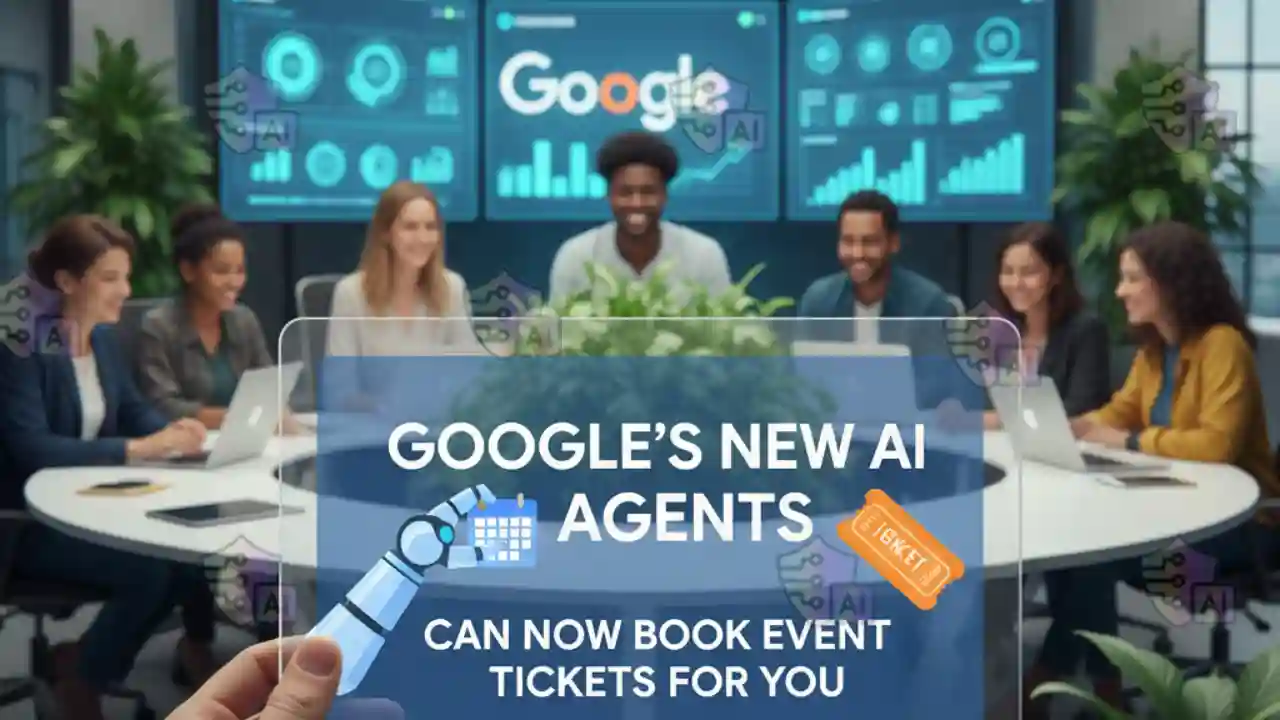
Google’s New AI Agents Can Now Book Event Tickets for You in 2025
Google has just taken another bold step into the world of artificial intelligence and this time, it’s all about convenience. The tech giant has unveiled new Google’s New AI Agents capable of booking event tickets on your behalf, making it easier than ever to get seats at concerts, movies, sporting events and more – all without lifting a finger. This latest addition builds on Google’s Gemini AI ecosystem, combining automation, context awareness, and natural language processing to tackle real-world tasks that previously required manual effort. In short, Google’s New AI Agents is no longer just answering your questions it’s taking real actions for you. The Evolution of Google’s New AI Agents Google’s AI journey has accelerated rapidly over the past year, driven by its advanced Gemini models. Initially designed for conversation, productivity and creative tasks, Gemini is now expanding into the realm of autonomous task management – a key step towards the next generation of intelligent digital assistants In early 2025, Google began testing “AI agents” – small, specialized programs capable of performing specific actions on users’ behalf. Unlike traditional assistants, these AI agents can operate independently, make context-based decisions, and interact with third-party platforms securely. Now, with ticket booking capabilities, Google’s AI agents can navigate ticketing websites, check availability, compare prices, and complete your purchase — all through simple commands like: “Hey Google, book two tickets for the Coldplay concert next weekend.” or “Find and reserve seats for the Lakers game this Friday night.” How Google’s New AI Agents Book Event Tickets? Powered by Gemini’s multimodal intelligence, this new capability processes complex tasks across platforms, combining text understanding, image recognition and logical reasoning to navigate digital interfaces with human-like intuition but with superior speed and accuracy. In practice, it starts when you issue a command, like booking concert tickets, AI checks the availability of connected ticketing platforms, personalizes suggestions based on your profile and preferences, and upon confirmation, executes a secure payment through Google Wallet. Finally, it automatically adds e-tickets to your Google Calendar and Gmail with relevant reminders, demonstrating an ongoing shift toward fully automated personal assistance that takes the friction out of everyday tasks. Why This Matters: The Future of AI Convenience? For many users, booking tickets is a small but time-consuming task. Between waiting rooms, limited seating, and sold out crowds, it often requires quick action and constant updates. Google’s new AI agents are designed to address these frustrations by offering three key advantages: 1. Time saving AI agents work instantly, checking multiple ticket sites in seconds while you continue with other tasks. 2. Smarter recommendations The system learns your entertainment preferences – from favorite artists to sports teams – and can suggest relevant events before you even ask. 3. Accessibility for all users Voice ticketing makes the process more inclusive, especially for users who have disabilities or are less comfortable with complex online forms. The move also represents Google’s broader push toward “actionable AI” — AI that not only provides information but can perform tasks directly in the real world. Privacy, Security, and Control As AI becomes more autonomous, privacy concerns inevitably arise. Google emphasized that AI agents operate under strict privacy protocols. Here’s how Google ensures user trust: Google’s approach aims to balance convenience with control, giving users the benefits of automation without sacrificing data safety. “Our goal is to make AI agents that act on your behalf but always under your supervision,” said a Google product lead during the announcement. How It Compares to Other AI Services? Google isn’t the only player experimenting with autonomous AI agents. OpenAI, Amazon, and Meta are developing similar tools to bring automation to personal and business lives. However, Google’s biggest advantage lies in the integration of its ecosystem connecting Gmail, Calendar, Wallet and Search into one seamless structure. What This Means for the Future? The launch of Google’s New AI Agents ticketing agents is more than just a feature update — it’s a preview of a future where AI handles routine tasks autonomously. In the coming years, we may see: Google’s mission is clear: make AI not only intelligent but also actionable, trustworthy, and human-centric. FAQS
Google Launches Gemini-Powered Home AI Assistant Across the US
Google has officially launched its Gemini-Powered Home AI Assistant in the United States – marking a huge step in the evolution of smart home technology. The new integration brings advanced conversational abilities, enhanced personalization, and seamless control of smart devices, transforming Google Home into one of the smartest AI ecosystems available today. With Gemini, Google isn’t just improving an assistant it’s redefining the way humans interact with their homes. In a major step towards the integration of artificial intelligence, Google has launched its Gemini-Powered Home AI Assistant in the United States. This launch marks a significant evolution from the previous Google Assistant, placing Gemini Google’s most advanced family of large language models at the center of the smart home experience. Unlike conventional assistants that primarily deal with simple commands, Gemini brings advanced reasoning, contextual understanding, and generative capabilities directly into users’ living spaces. He can engage in natural, multi-turn conversations, help plan meals based on what’s in the fridge, summarize long articles read aloud, or even generate creative bedtime stories for children all with remarkable fluency. What Is Gemini-Powered Home AI Assistant and Why It Matters? Gemini is Google’s most advanced artificial intelligence model, powered by Google DeepMind. It represents a new generation of AI that combines linguistic understanding, reasoning, creativity and multimodal capabilities meaning it can process text, audio, image and video inputs simultaneously. Unlike traditional assistants that rely on scripted responses or keyword triggers, Gemini understands context. It can follow complex instructions, remember past interactions, and deliver natural, human conversations due to Gemini-Powered Home AI Assistant. For example of Gemini-Powered Home AI Assistant: Google Home’s Evolution With Gemini AI Gemini-Powered Home AI Assistant has come a long way since its debut in 2016. Initially focused on voice commands and simple automation, it has gradually expanded into a connected ecosystem for controlling music, smart appliances, reminders and more. Now, with Gemini at its core, Google Home becomes an adaptive AI hub capable of understanding user intent and emotional tone. Gemini-Powered Home AI Assistant can be integrated into Nest devices, Android smartphones, YouTube and Google Calendar, creating a unified digital experience across all platforms. Key Upgrades with Gemini Integration: Features That Set Gemini Apart from Other AI Assistants Google aims to set a new benchmark for Gemini-Powered Home AI Assistant, leveraging its superior multimodal reasoning and real-time adaptation to gain a major advantage over competitors like Alexa and Siri. Gemini stands out for maintaining a natural, contextual conversation flow that feels genuinely human, and its deep integration with the entire Google ecosystem, from Gmail to Calendar, means it understands the user’s life outside of the home. Furthermore, it stands out for contextual learning, adapting to user patterns over time, and offers advanced visual understanding through intelligent displays to identify objects or assist with daily tasks. Finally, by monitoring connected appliances to suggest energy-saving routines, Gemini also aligns with smart and sustainable home management. What’s Next for Gemini and Google’s AI Ecosystem? Gemini-Powered Home AI Assistant US launch is just the beginning. According to Google, international expansion and more device integrations are expected in 2026. Gemini will soon power Pixel devices, Android Auto, Wear OS, and future Nest products, uniting Google’s entire ecosystem under an intelligent AI framework. Upcoming Features on the Horizon: This strategy signals Google’s goal to make Gemini the universal intelligence behind every Google product — much like how Android unified smartphones. “Gemini represents a new era of Gemini-Powered Home AI Assistant truly conversational, adaptive and personal,” said a Google spokesperson during the launch.” FAQs

New Study Reveals AI Assistants Are Giving Shockingly Wrong Answers in 2025
Artificial intelligence assistants like ChatGPT, Google Gemini, and Anthropic Claude were designed to give quick, confident answers, but a New Study Reveals AI Assistants has found that many of those answers are shockingly wrong. For all their smooth tone and intelligent phrasing, these AI tools often produce a stream of false, incomplete, or misleading information on almost any topic. AI Accuracy Under Fire According to recent research by independent analysts and universities, in more than 50% of real-world test cases, popular AI assistants came up with factually wrong answers. These ranged from historical inaccuracies and scientific misinterpretations all the way to simply fabricated statistics and references. AI Assistant Accuracy Score Error Type ChatGPT 65% Overconfident incorrect summaries Gemini 61% Data misinterpretation Claude 68% Missing context in answers Perplexity AI 72% Source reliability issues Why AI Assistants Give Wrong Answers? AI assistants are not connected to a “truth database.” Instead(New Study Reveals AI Assistants), they predict likely text patterns based on the data they’ve seen. This means it’s possible for them to create convincing but incorrect information as you know that AI hallucinations. Common causes include: What Experts Say about new study reveals aI assistants are giving shockingly wrong answers? AI researchers warn that public trust could drop if companies don’t make transparency a priority.About New Study Reveals AI Assistants Dr. Elena Ramirez, an ethics expert in AI, says: “The problem isn’t that AI makes mistakes, it’s that it makes them confidently.” Companies like OpenAI and Google DeepMind have promised better accuracy checks and real-time web verification, but many experts also say that users should verify the answers before relying on them for decisions. How to Identify Wrong AI Answers? Check Method Why It Helps Verify with multiple sources Confirms facts and avoids bias Use reputable databases Increases accuracy and reliability Ask for sources in AI chats Helps trace information origins Watch for overconfident tone AI may sound sure, even when wrong What Users Can Do? To avoid misinformation: FAQs
AI Browsers Like ChatGPT Atlas Spark New Privacy and Security Concerns in 2025
AI browsers like ChatGPT Atlas Spark New Privacy change the way humans interact with the internet by combining AI assistant capabilities, live browsing, and voice-driven searches into an experience far beyond what has until now been considered a browser. But this, of course comes with new types of problems: from data tracking and privacy leaks to AI-driven misinformation. What Are AI Browsers Like ChatGPT Atlas Spark New Privacy? AI browsers bring large-language-model capabilities directly to your browsing experience. With the likes of ChatGPT Atlas(ChatGPT Atlas Spark New Privacy), Perplexity AI, and aipromptshub.site, users can now: These features make browsing faster and more personalized, but they also raise data-collection and storage concerns. Feature Description Privacy Risk AI Summarization Reads and condenses pages automatically May log browsing data Voice Interaction Uses microphone input for voice chat Can collect voice samples Personalized Results Learns from user behavior Creates detailed user profiles Cloud Processing Relies on online AI servers Data may leave user’s device The Privacy & Security Debate While AI browsers offer unmatched convenience and intelligent browsing experiences, they rely heavily on continuous cloud communication, which raises serious privacy concerns. User data is often analyzed to enhance AI accuracy and ChatGPT Atlas Spark New Privacy, and in some cases, sensitive search information may be temporarily stored on remote servers. Privacy Concern Explanation Potential Risk Browsing Data Analysis AI browsers analyze user activity to improve accuracy User behavior may be tracked or profiled Sensitive Search Storage Queries can be stored on remote servers temporarily Risk of unauthorized data access Behavioral Tracking Browsers learn from habits and clicks Increased personalized ads and profiling Lack of Transparency Not all AI companies disclose data usage Users remain unaware of data handling policies How Developers Are Responding? Companies that develop AI browsers are addressing these concerns on privacy and security through several key measures, including the fact that many of them now use end-to-end encryption to ensure user queries and responses remain totally private. With local AI processing, some tasks can run directly on the user’s device, reducing dependence on cloud storage. You Can easy understand by given table 👇 Developer Measure Purpose Example End-to-End Encryption Keeps user queries and responses private ChatGPT Atlas encryption protocols Local AI Processing Runs models on your device to limit cloud exposure Apple and OpenAI edge-compute models Transparency Reports Shares what data is collected and how it’s used OpenAI and Google Cloud reports User Consent Controls Allows users to approve or deny data use Consent settings in browser extensions How to Stay Safe While Using AI Browsers Here are simple ways to keep your data protected: Action Why It Matters User Benefit Disable Microphone Access Prevents unwanted voice data collection Protects personal audio privacy Review Data Permissions Ensures only necessary access is granted Reduces hidden tracking Use Private Mode Limits cookies and stored search history Keeps sessions anonymous Avoid Sharing Sensitive Data AI chats can log inputs Prevents identity theft or leaks Clear Cache Regularly Removes saved logs and browsing data Maintains browser speed and safety The Future of AI Browsing AI browsers, such as ChatGPT Atlas Spark New Privacy, mark the beginning of a new era for the Internet-intelligent, conversational, and adaptive. But with this shift comes the need for stricter digital ethics and AI accountability. The balance of innovation and ChatGPT Atlas Spark New Privacy will decide just how far these tools can actually go. You Can easy understand by given table 👇 AI Trend Impact on Users Privacy Implication Conversational Browsing Faster, more natural web interaction May require more data access Smart Recommendations Personalized AI-driven content Potential over-personalization On-Device AI Models Increased privacy and performance Less dependency on cloud Digital Ethics Regulations Stronger global AI compliance Greater user protection FAQs ai innovatio