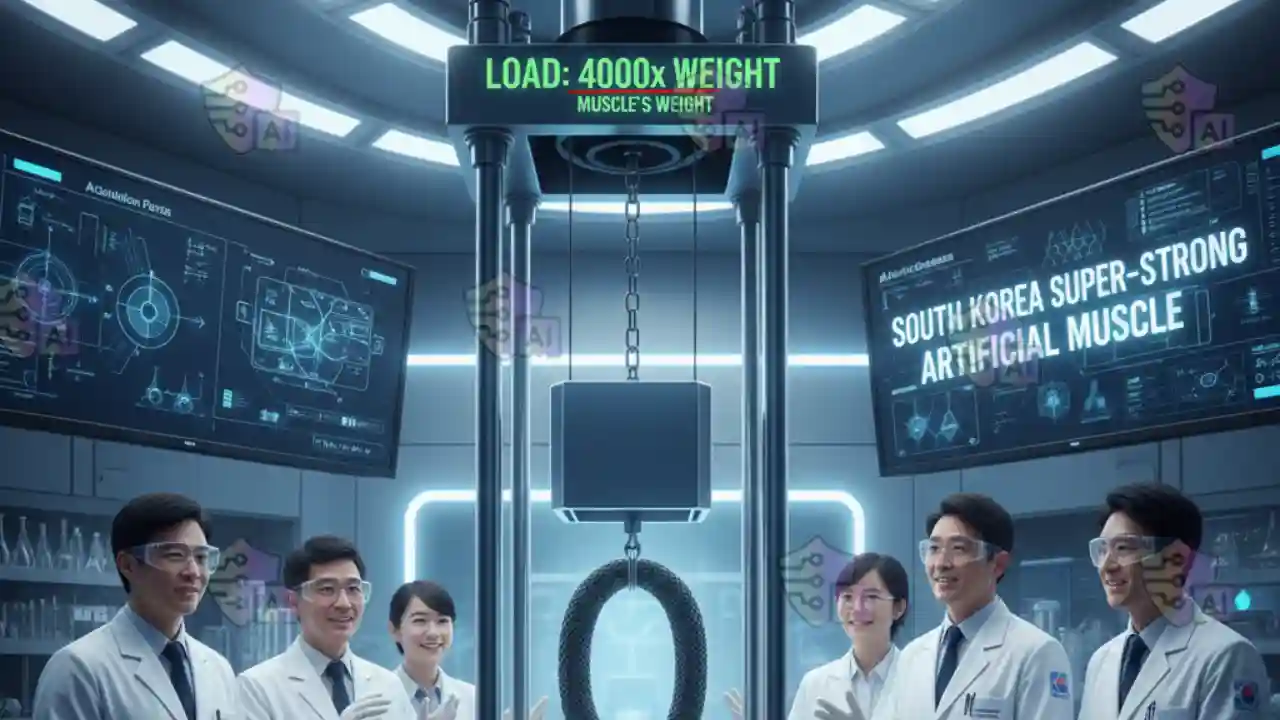
In a groundbreaking scientific achievement, South Korean Scientists Develop Artificial Muscle 4,000 Times Stronger Than Its Weight, marking a revolutionary advance in robotics, biomechanics and future prosthetics. This new muscle material not only mimics the flexibility and movement of real human muscle, but also surpasses it in strength, resilience and efficiency. The innovation represents a huge leap forward in the quest to create machines and prosthetics that move as naturally and as powerfully as living organisms. In a stunning leap forward for robotics and materials science, a team of South Korean Scientists Develop Artificial Muscle 4,000 Times Stronger Than Its Weight. This breakthrough, achieved by South Korean Scientists Develop Artificial Advanced Institute of Science and Technology (KAIST), promises to revolutionize fields ranging from soft robotics to medical devices and advanced prosthetics. The artificial muscle is constructed from a new high-performance actuator that operates on a principle known as “twisted polymer actuation.” Unlike traditional robotic muscles powered by bulky hydraulics or pneumatics, this new design uses incredibly thin, flexible strands of a specially designed polymer. When a small electrical current is applied, these polymeric fibers contract with immense force, imitating the contraction of human muscle fibers but with exponentially greater power in relation to their microscopic size. In this discovery, South Korean scientists develop artificial muscles capable of generating a force thousands of times greater than their own mass, a feat previously considered unattainable in the field of robotics and bioengineering. How South Korean Scientists Develop Artificial Muscle? South Korean scientists at the Korea Advanced Institute of Science and Technology (KAIST) have achieved a breakthrough in artificial muscle technology by developing a polymer-based actuator that demonstrates unprecedented strength relative to its weight. The main innovation lies not in the discovery of new materials, but in the revolutionary structural engineering of existing polymers. The researchers created these artificial muscles using a “twisted polymer actuator” approach. They started with common high-strength polymer fibers, similar to those used in fishing line, and twisted them into tight, coiled structures, similar to springs. This coiled geometry is crucial to the technology’s performance, as it provides a mechanical advantage much like a pulley system allowing heavy loads to be lifted with minimal force. Through this innovative method, South Korean scientists develop artificial muscle fibers that combine strength, flexibility and efficiency, setting a new benchmark in robotics and materials engineering. To activate the muscle, the South Korean Scientists Develop Artificial integrated a conductive mesh of nanowires throughout the coiled polymer. When a small electrical current passes through this mesh, it generates gentle, controlled heat through Joule heating. The polymer responds to this thermal change by contracting significantly, with the coiled structure amplifying this contraction into a tremendous tensile force. The combination of coiled geometry and thermal response creates by South Korean Scientists Develop Artificial muscle that can generate forces up to 4,000 times its own weight. This represents a dramatic improvement over previous artificial muscle technologies, which typically struggled with balancing strength, weight and flexibility. The technology promises to revolutionize fields ranging from soft robotics and medical devices to advanced prosthetics, enabling powerful yet lightweight robotic systems that more closely mimic biological movement. How It Works: The Science Behind Artificial Strength The newly South Korean Scientists Develop Artificial muscle is based on electroactive polymer technology, enhanced with nanomaterials for greater energy density and flexibility See how it works: Real-World Applications: Where Artificial Muscles Will Make a Difference The rise of South Korean Scientists Develop Artificial muscle technology is transforming both robotics and prosthetics, two fields that share a common goal replicating the complexity and grace of human movement. By replacing rigid motors and mechanical joints with soft, flexible artificial fibers, scientists are unlocking a new generation of machines and prosthetic devices that move with unprecedented realism, strength and precision. In robotics, these muscles allow machines to bend, twist and lift with fluid movements mimicking the flexibility of living organisms. Meanwhile, in the field of prosthetics: Global Impact and Future of this technology This discovery of South Korean Scientists Develop Artificial at the forefront of global robotics research, joining other leaders like Japan, the United States, and China in advancing next-generation AI-driven materials. Experts predict that within the next decade, artificial muscles could: “This is more than just a scientific breakthrough it’s a blueprint for the future of human-machine interaction,” said one materials science expert. FAQs
Google Launches Gemini-Powered Home AI Assistant Across the US
Google has officially launched its Gemini-Powered Home AI Assistant in the United States – marking a huge step in the evolution of smart home technology. The new integration brings advanced conversational abilities, enhanced personalization, and seamless control of smart devices, transforming Google Home into one of the smartest AI ecosystems available today. With Gemini, Google isn’t just improving an assistant it’s redefining the way humans interact with their homes. In a major step towards the integration of artificial intelligence, Google has launched its Gemini-Powered Home AI Assistant in the United States. This launch marks a significant evolution from the previous Google Assistant, placing Gemini Google’s most advanced family of large language models at the center of the smart home experience. Unlike conventional assistants that primarily deal with simple commands, Gemini brings advanced reasoning, contextual understanding, and generative capabilities directly into users’ living spaces. He can engage in natural, multi-turn conversations, help plan meals based on what’s in the fridge, summarize long articles read aloud, or even generate creative bedtime stories for children all with remarkable fluency. What Is Gemini-Powered Home AI Assistant and Why It Matters? Gemini is Google’s most advanced artificial intelligence model, powered by Google DeepMind. It represents a new generation of AI that combines linguistic understanding, reasoning, creativity and multimodal capabilities meaning it can process text, audio, image and video inputs simultaneously. Unlike traditional assistants that rely on scripted responses or keyword triggers, Gemini understands context. It can follow complex instructions, remember past interactions, and deliver natural, human conversations due to Gemini-Powered Home AI Assistant. For example of Gemini-Powered Home AI Assistant: Google Home’s Evolution With Gemini AI Gemini-Powered Home AI Assistant has come a long way since its debut in 2016. Initially focused on voice commands and simple automation, it has gradually expanded into a connected ecosystem for controlling music, smart appliances, reminders and more. Now, with Gemini at its core, Google Home becomes an adaptive AI hub capable of understanding user intent and emotional tone. Gemini-Powered Home AI Assistant can be integrated into Nest devices, Android smartphones, YouTube and Google Calendar, creating a unified digital experience across all platforms. Key Upgrades with Gemini Integration: Features That Set Gemini Apart from Other AI Assistants Google aims to set a new benchmark for Gemini-Powered Home AI Assistant, leveraging its superior multimodal reasoning and real-time adaptation to gain a major advantage over competitors like Alexa and Siri. Gemini stands out for maintaining a natural, contextual conversation flow that feels genuinely human, and its deep integration with the entire Google ecosystem, from Gmail to Calendar, means it understands the user’s life outside of the home. Furthermore, it stands out for contextual learning, adapting to user patterns over time, and offers advanced visual understanding through intelligent displays to identify objects or assist with daily tasks. Finally, by monitoring connected appliances to suggest energy-saving routines, Gemini also aligns with smart and sustainable home management. What’s Next for Gemini and Google’s AI Ecosystem? Gemini-Powered Home AI Assistant US launch is just the beginning. According to Google, international expansion and more device integrations are expected in 2026. Gemini will soon power Pixel devices, Android Auto, Wear OS, and future Nest products, uniting Google’s entire ecosystem under an intelligent AI framework. Upcoming Features on the Horizon: This strategy signals Google’s goal to make Gemini the universal intelligence behind every Google product — much like how Android unified smartphones. “Gemini represents a new era of Gemini-Powered Home AI Assistant truly conversational, adaptive and personal,” said a Google spokesperson during the launch.” FAQs