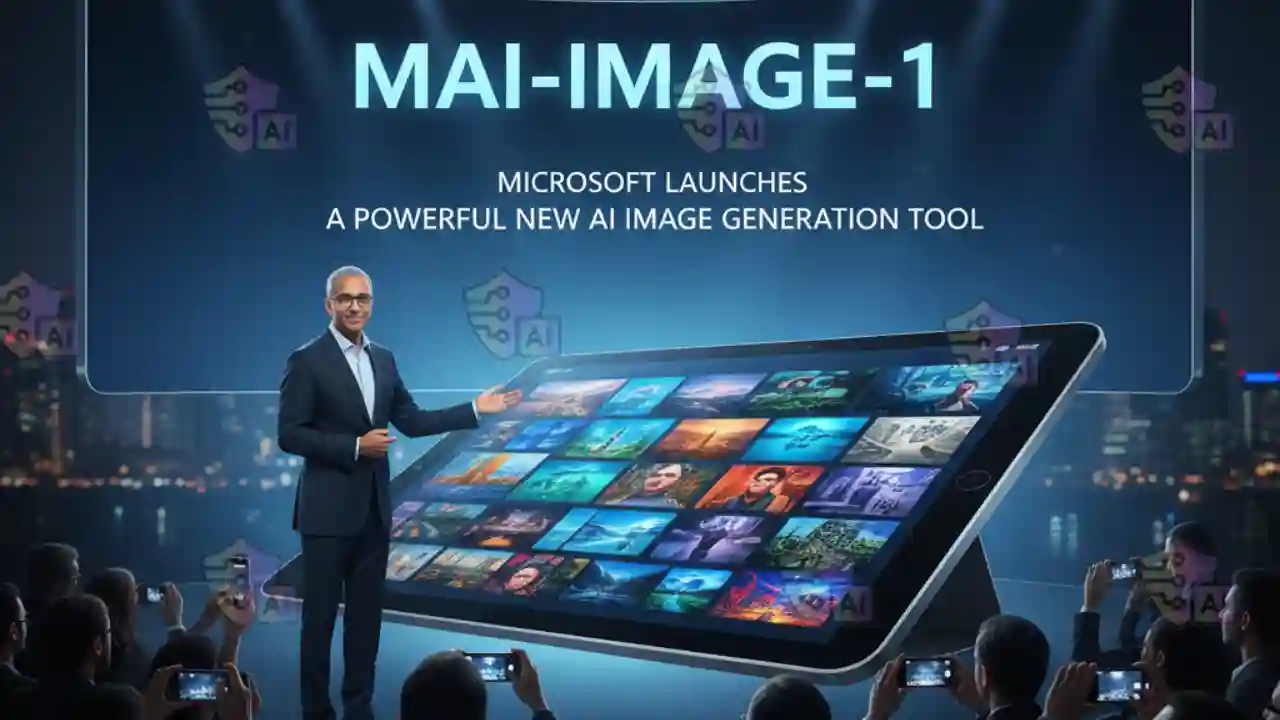
Artificial Intelligence continues to redefine the way we create, design and visualize ideas. Now, Microsoft is taking another bold step with the launch of its first in-house AI image generator, officially called MAI-Image-1 by Microsoft Launches MAI-Image-1. This innovative tool allows users to create detailed, realistic and imaginative images directly from simple text instructions marking an important milestone in Microsoft’s growing generative AI ecosystem. Microsoft has officially entered the competitive AI imaging arena with the launch of MAI-Image-1, a powerful new tool designed to challenge established leaders. The introduction of MAI-Image-1 represents Microsoft’s strategic move to leverage its AI research into practical creative applications. Built on an advanced proprietary architecture, Microsoft Launches MAI-Image-1 promises highly detailed photorealistic images from simple text prompts, with a particular focus on visual accuracy and coherence. The implementation of MAI-Image-1 deepens the integration of Microsoft’s generative AI across its ecosystem, positioning it as a secure, enterprise-grade solution. Although currently in limited access preview, this release of Microsoft Launches MAI-Image-1 signals Microsoft’s strong ambition to become a dominant force in visual AI, offering creators and businesses a new and reliable option for imaging. What Is Microsoft Launches MAI-Image-1? MAI-Image-1 (short for Microsoft Artificial Intelligence Image 1) is the company’s first in-house developed AI image generator, designed to rival popular tools like DALL·E, Midjourney, and Adobe Firefly. Unlike Microsoft’s previous integrations with OpenAI models, MAI-Image-1 represents an independent effort – designed and trained by Microsoft’s own AI research division. The model is capable of generating high-quality images, illustrations, and concept art from natural language descriptions. The goal behind MAI-Image-1 is simple yet powerful: To make creative image generation faster, smarter, and more accessible directly within Microsoft’s ecosystem. This means users could soon generate AI art right inside Microsoft 365, Edge browser, or even Windows Copilot, without needing any third-party service. How MAI-Image-1 Works? Basically, Microsoft Launches MAI-Image-1 operates on advanced text-to-image diffusion models trained on vast open-source and licensed image datasets. When you type a description like “futuristic city skyline at sunset in watercolor style,” the AI interprets your words, understands the context, and produces a detailed, realistic image that matches your intent. Key technologies powering MAI-Image-1 include: How to Use MAI-Image-1? Getting started with MAI-Image-1 is simple. Microsoft plans to make it available through its major platforms including Microsoft Edge, Copilot, and Microsoft Designer. Here’s how you can use it: Step 1: Access the Tool Step 2: Enter Your Prompt Type a descriptive text prompt such as: “A minimalist logo of a mountain with sunrise in gradient colors.” Step 3: Customize the Output You can choose: Step 4: Generate & Edit Click “Create” the AI generates multiple versions. You can refine or edit using built-in tools for background removal, color adjustment, and upscaling. Step 5: Download or Use in Microsoft Apps Once done, you can: Comparison: MAI-Image-1 vs Other AI Image Generators Feature MAI-Image-1 (Microsoft) DALL·E 3 Midjourney Adobe Firefly Developer Microsoft OpenAI Midjourney Inc. Adobe Integration Microsoft 365, Edge, Designer ChatGPT, Bing Discord Adobe Creative Cloud Style Options Wide, controllable via prompt Limited presets Artistic, detailed Photorealistic Privacy High (in-house) Moderate Moderate High Image Quality 4K+ 2K 4K 2K Cost Likely free for Microsoft users Subscription Subscription Subscription FAQs

Nokia CEO Says AI Boom Mirrors the 1990s Internet Era But Without the Bubble
Artificial intelligence (AI) is reshaping industries at a breathtaking pace from healthcare to amusement, and from logistics to communication. According to Nokia CEO Pekka Lundmark, this transformation is reminiscent of the internet AI Boom Mirrors of the Nineteen Nineties, when the sector witnessed the dawn of digital connectivity. But in contrast to the dot-com technology, Lundmark insists this AI surge is not simply hype. Instead, it’s built on strong technological progress, global funding, and proven business programs that means it’s more sustainable than speculative. Lundmark said in a latest interview. “We are at the beginning of an AI revolution much like what the internet represented within the Nineteen Nineties, however this time, it’s real,” From the Internet Revolution to the AI Renaissance In the Nineteen Nineties, the net become the vibrant new frontier complete of promise however also plagued by using overvaluation and unrealistic expectations. Many startups rose quick and collapsed simply as speedy at some stage in the dot-com bubble. However, the virtual infrastructure built at some point of that point information centers, networking technology, and mobile communications laid the foundation for today’s connected world.Now, records appears to be repeating itself with AI Boom Mirrors. Just because the net connected human beings globally, AI is connecting data, structures, and selection-making approaches. The pace of innovation, the flood of project capital, and the excitement throughout industries are all paying homage to the internet’s early days. But the distinction, consistent with Lundmark, is this time we’re now not building on hypothesis we’re building on decades of virtual adulthood, system studying improvements, and real-global use instances. Why the AI Boom Mirrors Is Built on Stronger Ground? Unlike the dot-com era, today’s AI expansion rests on tangible outcomes and sturdy foundations. Here’s why many enterprise leaders along with Nokia agree with this growth is constructed to remaining: How Nokia Is Embracing the AI Revolution? While Nokia CEO is regularly remembered for its mobile cellphone legacy, the employer has developed into a international leader in virtual infrastructure and community intelligence. Under CEO Pekka Lundmark’s management, Nokia has deeply integrated AI Boom Mirrors and machine learning across its core operations optimizing networks, enhancing performance, and powering the next generation of connectivity. AI’s Parallels with the 1990s Internet Era 1990s Internet Boom Mirrors 2020s AI Boom Mirrors Rise of online businesses Rise of AI-driven companies Overvalued startups Rapidly funded AI startups Limited infrastructure Global 5G and cloud ecosystem New consumer behaviors AI-integrated products and services Speculative hype Data-driven innovation The Future Outlook: AI as the Backbone of Innovation According to Lundmark, the AI Boom Mirrors continues to be in its early innings. Just as the internet became the inspiration for e-commerce, social media, and digital conversation, AI will quickly underpin the entirety from company automation to creative industries. He predicts three major shifts: Lundmark said. “The businesses that learn how to harness it responsibly will lead the following commercial revolution.” FAQs

Google Gemini Brings Gemini-Powered AI Assistant to Cars, A Game-Changer for Drivers in 2025
Google accelerates into the future with Gemini-Powered AI Assistant, its most advanced AI model, making its way into vehicles by 2025. This innovative move will merge generative AI’s abilities with driving, providing drivers with a more intelligent, responsive assistant who tunes in to every whim on the road.Think of it like a voice-aware car that’s as smooth with your voice as a human passenger, prescient to your needs before you even open your mouth, and turns your car from a mere mode of transport to a genuinely intelligent companion. It’s not the stuff of sci-fi-it’s the future Google is rolling out onto every road by Gemini-Powered AI Assistant in 2025. What is Google Gemini AI for Cars? Google Gemini represents the next evolution of automotive AI, moving far beyond today’s basic voice commands into truly conversational, context-aware artificial intelligence designed specifically for the driving environment. The Gemini AI assistant is not just another voice command system. Unlike traditional assistants like Android Auto or Google Assistant, Gemini brings advanced reasoning, multimodal input, and real-time learning to vehicles. Generation Technology Capabilities Limitations 1st Gen (2000s) Basic Voice Commands Call home, Play CD Limited vocabulary, no context 2nd Gen (2010s) Connected Assistants Find gas stations, Play Spotify Pre-set commands only 3rd Gen (2020s) Smart Assistants I’m hungry → finds restaurants Better but still scripted 4th Gen (2025+) Google Gemini AI Full conversations, predictive help, emotional intelligence Requires internet connection Key Differentiators: Features and Capabilities The Gemini automotive AI isn’t just an upgrade, it’s a complete reimagining of what a car assistant can do. Feature Category Specific Capabilities User Benefit Available In Natural Conversations Follow-up questions, humor, complex commands Feels like talking to knowledgeable friend All models Advanced Navigation Real-time traffic prediction, weather routing, personalized stops Saves 15-30 minutes on typical commute Premium tier Vehicle Health Predictive maintenance alerts, self-diagnosis, service scheduling Prevents breakdowns, saves repair costs All models Entertainment Control Smart content suggestions, mood-based music, podcast management Perfect entertainment every trip All models Safety Monitoring Driver alertness detection, obstacle warning, emergency response Reduces accident risk by up to 40% Safety package Smart Home Integration Pre-heat home, open garage, security controls Seamless home-to-car experience Smart home bundle How Gemini Compares to Current Automotive AI? The automotive AI landscape is competitive, but Gemini brings unique advantages that set it apart. Feature Google Gemini Apple Siri CarPlay Amazon Alexa Auto BMW Natural Interaction Conversational Depth Full dialogues with memory Single commands Single commands Limited dialogues Predictive Abilities Advanced learning Basic suggestions Routine-based Minimal Integration Ecosystem Google services + third-party Apple ecosystem only Amazon services + limited Manufacturer-specific Update Frequency Continuous cloud updates Major iOS updates Periodic updates Model year updates Privacy Controls Granular permission system Standard Apple privacy Amazon privacy settings BMW privacy terms Cost Structure Subscription after 3 years Free with iPhone Free with Prime Manufacturer dependent Implementation and Vehicle Partnerships Google’s move to bring the Gemini-powered AI assistant into cars isn’t merely a software upgrade; it’s part of a strategic push for partnerships across the global automotive industry. In-vehicle integration would mean directly embedding Gemini AI deep inside the ecosystem of the vehicle, ensuring seamless integration of hardware, cloud services, and real-time driving experiences. This approach allows for: Privacy, Safety, and Future Roadmap As Google Gemini accelerates toward its 2025 rollout in vehicles, the company faces growing questions around data privacy, driver safety, and long-term AI governance. While Gemini promises a smarter, more personalized driving experience, Google must balance innovation with responsibility: ensuring AI-powered cars are safe, transparent, and privacy-centric. Concern Area Google’s Solution User Control Industry Standard Data Collection Anonymous driving data only Opt-out possible Typically opt-in required Voice Recording Processed locally when possible Delete history anytime Often stored on servers Location Tracking Only during active navigation Pause location history Usually constant tracking Biometric Data Driver alertness monitoring only Disable monitoring Varies by manufacturer Third-Party Sharing No data selling to advertisers Control sharing permissions Often shared with partners Data Retention Automatic deletion after 18 months Manual immediate deletion Typically indefinite FAQs

Netflix Goes All-In on Generative AI, Shaking Up Hollywood’s Future Forever 2026
The entertainment industry is at a fork in the road due to Netflix Goes All-In on Generative AI. In the not too distant future, Hollywood will be completely transformed by the seismic shift that is represented by generative AI with Netflix ‘all in.’ Scripts written by artificial intelligence, actors created digitally this is the future of storytelling. It’s revolutionary, or is it risky? This blog goes deep on how Netflix Goes All-In on Generative AI ambitions are remaking content creation, reception throughout the industry, and what comes next for entertainment as a whole. Netflix Goes All-In on Generative AI Strategy: A Game Changer for Content Creation Netflix Goes All-In on Generative AI to streamline and innovate content production. By use AI tools into scripting, animation, and post-production, the platform aims to reduce costs, speed up workflows, and deliver hyper-personalized viewer experiences. Area of Use How AI Is Applied Examples Scriptwriting AI tools generate plot ideas and dialogues Drafting alternate storylines Animation Creating dynamic characters and environments Reducing manual illustration efforts Post-Production Enhancing visual effects and editing Automated color grading, scene transitions Personalization Tailoring trailers and thumbnails for users Custom previews based on viewing history Hollywood’s Divide: Embracing AI vs. Protecting Creativity While Netflix Goes All-In on Generative AI, the broader entertainment industry remains split. Since making its initial foray into the technology in 2023, Netflix has been steadily building towards this moment. Studios like using Genai, Disney are cautiously experimenting, while guilds and creators voice strong opposition over ethical and creative concerns. Stakeholder Stance on AI Key Arguments Streaming Giants Pro-adoption for scalability Cost efficiency and innovation Film Studios Cautious integration Balancing creativity with technology Writers’ Guild Strong opposition Job security and creative integrity Independent Creators Mixed reactions New tools vs. loss of uniqueness How Generative AI Is Transforming Content Creation Generative AI is revolutionizing every stage of content creation, from pre-production to distribution. Netflix’s use cases highlight its potential to redefine storytelling. Stage AI Application Netflix’s Implementation Pre-Production Script analysis, casting suggestions AI-driven audience insights for greenlighting Production Virtual sets, AI-assisted cinematography Reducing location costs Post-Production Editing, sound design, VFX Automated subtitling and dubbing Distribution Personalized marketing campaigns Dynamic thumbnails and trailers The Future of Hollywood: Will AI Dominate or Collaborate? The integration of AI into Hollywood’s fabric raises a critical question: Will machines replace human creativity, or will they serve as collaborative partners? Scenario Likelihood Impact on Industry Full AI Adoption Medium Maximized efficiency but generic content Hybrid Model High Balanced innovation and creativity AI Regulation Medium Slower adoption with ethical safeguards Creator-Led Backlash Low Limited AI use, focus on human artistry Viewer Experience: The Good and The Bad of AI-Driven Entertainment For audiences, Netflix Goes All-In on Generative AI promises hyper-personalized content but also risks creating echo chambers and reducing serendipitous discovery. Aspect Pros of AI Integration Cons of AI Integration Personalization Tailored recommendations Limited exposure to diverse content Content Variety Niche genres and experimental formats Over-saturation of similar themes Accessibility AI-powered subtitles and dubbing Loss of authentic cultural context Engagement Interactive and choose-your-own-adventure shows Predictable and formulaic narratives The Engine Room: Inside Netflix’s Machine Learning Platform and GenAI Tools Netflix Goes All-In on Generative AI transformation is powered by sophisticated machine learning platforms and generative AI tools designed to revolutionize content creation. While the entertainment industry remains divided about the use of AI, Netflix Goes All-In on Generative AI is seeing significant benefits in production through various applications. Aspect Technology/Platform Application Impact/Benefit Key Statements Core Strategy Machine Learning Platform Entertainment industry-specific AI solutions Enhanced content creation and understanding “All in bet on AI transformation” Tools & Capabilities Generative AI Tools • Video Classifiers • Vision-Language Models Content tagging • Demand modeling • Digital replicas • AI-generated scenes 60% faster production • Cost-effective VFX • Better content decisions “Incredible opportunity to help creators make films and series better” Production Enhancement AI-powered Video Annotator • Experimentation Platform • Pre-visualization Tools Pre-production planning • Scene generation • Actor digital replicas More efficient workflows • Reduced traditional VFX costs “Real work with better tools for creative partners” Current Deployments GenAI Recommendation Systems • Content Production AI • Eternaut Project Personalized content • Anime production • Marketing assets 25% higher engagement • 40% faster production “AI technology demonstrates clear commitment” Industry Position Content Understanding Platform • Production Planning Tools Storytelling enhancement • Creative partner support Balanced innovation approach “Tools won’t automatically make you a great storyteller” Quality Metrics AI-generated Visual Effects • Traditional VFX Comparison Scene generation • Effect enhancement Indistinguishable from traditional VFX “Beginning of a new era in content creation” Industry Impact Evolving Legal Framework • Creator Concerns Hollywood divisions • Actor/writer concerns Ongoing industry adaptation “Entertainment industry remains divided” FAQs