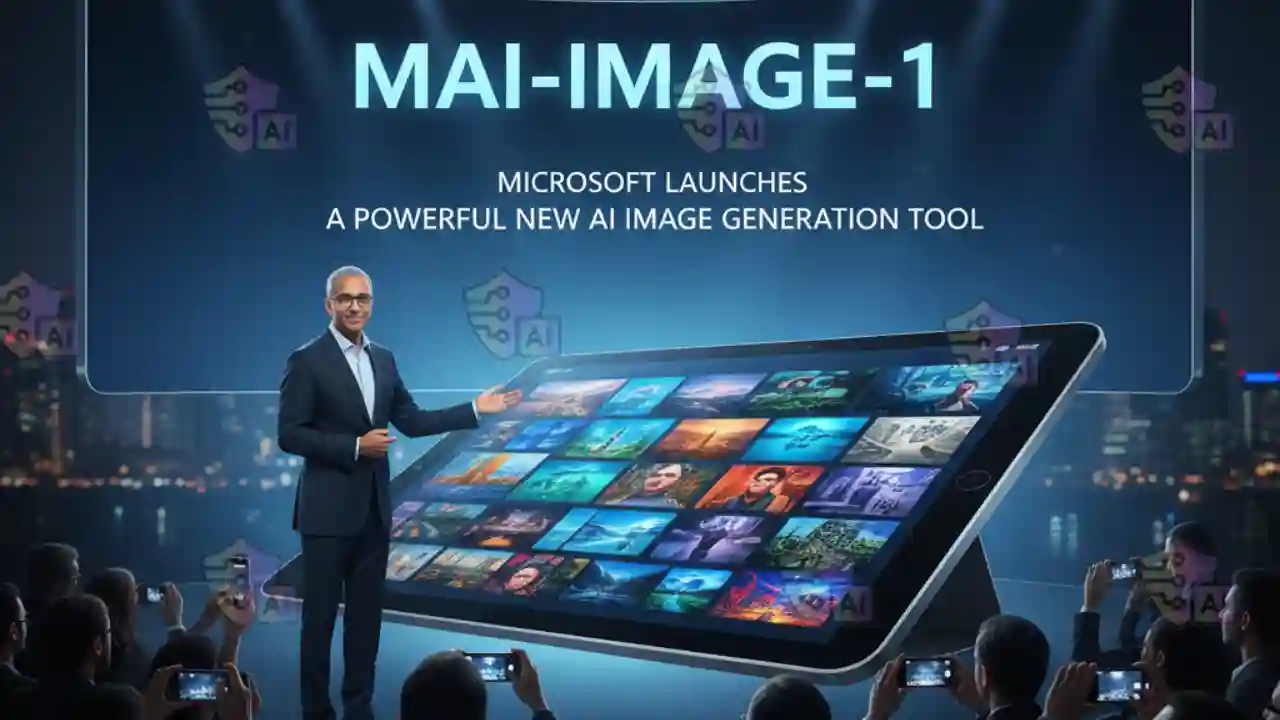
Artificial Intelligence continues to redefine the way we create, design and visualize ideas. Now, Microsoft is taking another bold step with the launch of its first in-house AI image generator, officially called MAI-Image-1 by Microsoft Launches MAI-Image-1. This innovative tool allows users to create detailed, realistic and imaginative images directly from simple text instructions marking an important milestone in Microsoft’s growing generative AI ecosystem. Microsoft has officially entered the competitive AI imaging arena with the launch of MAI-Image-1, a powerful new tool designed to challenge established leaders. The introduction of MAI-Image-1 represents Microsoft’s strategic move to leverage its AI research into practical creative applications. Built on an advanced proprietary architecture, Microsoft Launches MAI-Image-1 promises highly detailed photorealistic images from simple text prompts, with a particular focus on visual accuracy and coherence. The implementation of MAI-Image-1 deepens the integration of Microsoft’s generative AI across its ecosystem, positioning it as a secure, enterprise-grade solution. Although currently in limited access preview, this release of Microsoft Launches MAI-Image-1 signals Microsoft’s strong ambition to become a dominant force in visual AI, offering creators and businesses a new and reliable option for imaging. What Is Microsoft Launches MAI-Image-1? MAI-Image-1 (short for Microsoft Artificial Intelligence Image 1) is the company’s first in-house developed AI image generator, designed to rival popular tools like DALL·E, Midjourney, and Adobe Firefly. Unlike Microsoft’s previous integrations with OpenAI models, MAI-Image-1 represents an independent effort – designed and trained by Microsoft’s own AI research division. The model is capable of generating high-quality images, illustrations, and concept art from natural language descriptions. The goal behind MAI-Image-1 is simple yet powerful: To make creative image generation faster, smarter, and more accessible directly within Microsoft’s ecosystem. This means users could soon generate AI art right inside Microsoft 365, Edge browser, or even Windows Copilot, without needing any third-party service. How MAI-Image-1 Works? Basically, Microsoft Launches MAI-Image-1 operates on advanced text-to-image diffusion models trained on vast open-source and licensed image datasets. When you type a description like “futuristic city skyline at sunset in watercolor style,” the AI interprets your words, understands the context, and produces a detailed, realistic image that matches your intent. Key technologies powering MAI-Image-1 include: How to Use MAI-Image-1? Getting started with MAI-Image-1 is simple. Microsoft plans to make it available through its major platforms including Microsoft Edge, Copilot, and Microsoft Designer. Here’s how you can use it: Step 1: Access the Tool Step 2: Enter Your Prompt Type a descriptive text prompt such as: “A minimalist logo of a mountain with sunrise in gradient colors.” Step 3: Customize the Output You can choose: Step 4: Generate & Edit Click “Create” the AI generates multiple versions. You can refine or edit using built-in tools for background removal, color adjustment, and upscaling. Step 5: Download or Use in Microsoft Apps Once done, you can: Comparison: MAI-Image-1 vs Other AI Image Generators Feature MAI-Image-1 (Microsoft) DALL·E 3 Midjourney Adobe Firefly Developer Microsoft OpenAI Midjourney Inc. Adobe Integration Microsoft 365, Edge, Designer ChatGPT, Bing Discord Adobe Creative Cloud Style Options Wide, controllable via prompt Limited presets Artistic, detailed Photorealistic Privacy High (in-house) Moderate Moderate High Image Quality 4K+ 2K 4K 2K Cost Likely free for Microsoft users Subscription Subscription Subscription FAQs

Microsoft Fixes AI Creation Tool Crashes Caused by Latest Windows Update 2025
Microsoft has officially fixed a major issue affecting the AI Creation Tool, which had crashed for users after the latest Windows update. Now Microsoft Fixes AI Creation Tool after widespread reports of instability, particularly among creators and developers using Microsoft’s AI-powered features for image generation, content creation and app prototyping. This event highlights both the rapid development of Microsoft’s AI tools and the growing pains of integrating artificial intelligence deeper into the Windows ecosystem. Understanding the AI Creation Tool and Its Role in Windows The Microsoft AI Creation Tool is part of the company’s broader initiative to build AI capabilities into Windows and productivity apps. It helps users generate creative assets, automate workflows, and use AI models for image, text, and video creation. From Copilot integrations in Windows 11 to tools like Designer, Paint Cocreator and Clipchamp AI, Microsoft has turned the OS into a full AI-powered platform due to Microsoft Fixes AI Creation Tool. The AI Creation Tool plays a key role in this ecosystem acting as a bridge between user creativity and Microsoft’s underlying AI framework. After the latest Windows update was rolled out in early October, users started reporting persistent crashes when launching or rendering AI-generated projects. The Root of the Problem: What Caused the Crashes? The crash reports started popping up across Microsoft’s Feedback Hub and Reddit threads about that Microsoft Fixes AI Creation Tool. Microsoft’s engineering team confirmed that the crashes were related to a compatibility conflict between the AI Creation Tool and a system-level update in the latest Windows update (build 22631.2900 for Windows 11). According to user reports, the problem usually occurred when: The crash was caused by a memory allocation error that prevented the AI rendering process from completing therfore Microsoft Fixes AI Creation Tool. Essentially, the system’s AI compute resources (connected to DirectML and GPU acceleration) were blocked by a faulty background process introduced in the update. As a result, the AI Creation Tool could not access the necessary resources – leading to sudden shutdowns, incomplete renderings, or broken AI projects. Microsoft’s Response and the Fix To Microsoft’s credit, it act quickly. Within days, the company’s Windows Insider team released an update through the Windows Update Catalog and the Microsoft Store that addresses the underlying issue. Microsoft also confirmed that it has improved error logging in the AI Creation Tool by Microsoft Fixes AI Creation Tool, allowing faster detection of similar issues in the future. Some of Fix Details are given below: Comparison: Before vs After Patch Here’s a quick comparison showing how the patch improved the tool’s stability and performance by Microsoft Fixes AI Creation Tool: Feature / Test Before Patch After Patch (KB5043256) AI Image Rendering Crashes after 30–40% progress Completed smoothly Video Generation Lag spikes & forced shutdowns Stable playback GPU Utilization 95% usage before crash Balanced at 75–80% Export Success Rate 55% 98% System Memory Errors Frequent Resolved The Bigger Picture: Microsoft’s AI Push Continues This issue may have been a setback, but it’s part of a much larger narrative. Microsoft Fixes AI Creation Tool, embedding tools across Windows, Office 365 and Azure. By connecting all these tools together, Microsoft aims to create a seamless AI workflow where users can go from idea to execution with minimal friction. By Microsoft Fixes AI Creation Tool, Some of Key AI initiatives by Microsoft are given below: Looking Ahead: Stability and Innovation Hand in Hand After Microsoft Fixes AI Creation Tool, Microsoft has assured users that future updates will prioritize stability for AI-powered tools. The company is also investing in AI performance monitoring frameworks that can detect and fix software conflicts before they affect end users. In the long run, this will be crucial as more creators, developers and businesses adopt AI creation tools as part of their daily workflow. The tech giant is also working with GPU partners such as NVIDIA and AMD to optimize DirectML (Microsoft’s AI acceleration layer) – to ensure AI rendering and content generation continues to improve across all tiers of hardware. FAQs