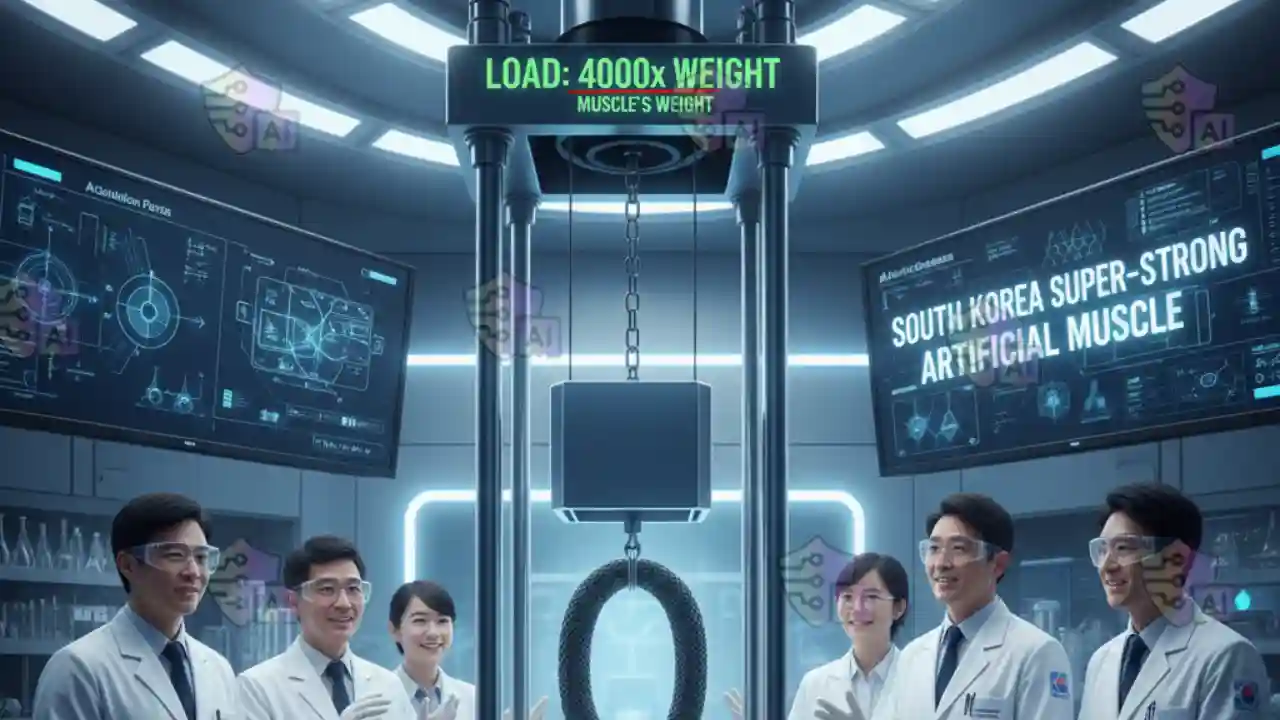
In a groundbreaking scientific achievement, South Korean Scientists Develop Artificial Muscle 4,000 Times Stronger Than Its Weight, marking a revolutionary advance in robotics, biomechanics and future prosthetics. This new muscle material not only mimics the flexibility and movement of real human muscle, but also surpasses it in strength, resilience and efficiency. The innovation represents a huge leap forward in the quest to create machines and prosthetics that move as naturally and as powerfully as living organisms. In a stunning leap forward for robotics and materials science, a team of South Korean Scientists Develop Artificial Muscle 4,000 Times Stronger Than Its Weight. This breakthrough, achieved by South Korean Scientists Develop Artificial Advanced Institute of Science and Technology (KAIST), promises to revolutionize fields ranging from soft robotics to medical devices and advanced prosthetics. The artificial muscle is constructed from a new high-performance actuator that operates on a principle known as “twisted polymer actuation.” Unlike traditional robotic muscles powered by bulky hydraulics or pneumatics, this new design uses incredibly thin, flexible strands of a specially designed polymer. When a small electrical current is applied, these polymeric fibers contract with immense force, imitating the contraction of human muscle fibers but with exponentially greater power in relation to their microscopic size. In this discovery, South Korean scientists develop artificial muscles capable of generating a force thousands of times greater than their own mass, a feat previously considered unattainable in the field of robotics and bioengineering. How South Korean Scientists Develop Artificial Muscle? South Korean scientists at the Korea Advanced Institute of Science and Technology (KAIST) have achieved a breakthrough in artificial muscle technology by developing a polymer-based actuator that demonstrates unprecedented strength relative to its weight. The main innovation lies not in the discovery of new materials, but in the revolutionary structural engineering of existing polymers. The researchers created these artificial muscles using a “twisted polymer actuator” approach. They started with common high-strength polymer fibers, similar to those used in fishing line, and twisted them into tight, coiled structures, similar to springs. This coiled geometry is crucial to the technology’s performance, as it provides a mechanical advantage much like a pulley system allowing heavy loads to be lifted with minimal force. Through this innovative method, South Korean scientists develop artificial muscle fibers that combine strength, flexibility and efficiency, setting a new benchmark in robotics and materials engineering. To activate the muscle, the South Korean Scientists Develop Artificial integrated a conductive mesh of nanowires throughout the coiled polymer. When a small electrical current passes through this mesh, it generates gentle, controlled heat through Joule heating. The polymer responds to this thermal change by contracting significantly, with the coiled structure amplifying this contraction into a tremendous tensile force. The combination of coiled geometry and thermal response creates by South Korean Scientists Develop Artificial muscle that can generate forces up to 4,000 times its own weight. This represents a dramatic improvement over previous artificial muscle technologies, which typically struggled with balancing strength, weight and flexibility. The technology promises to revolutionize fields ranging from soft robotics and medical devices to advanced prosthetics, enabling powerful yet lightweight robotic systems that more closely mimic biological movement. How It Works: The Science Behind Artificial Strength The newly South Korean Scientists Develop Artificial muscle is based on electroactive polymer technology, enhanced with nanomaterials for greater energy density and flexibility See how it works: Real-World Applications: Where Artificial Muscles Will Make a Difference The rise of South Korean Scientists Develop Artificial muscle technology is transforming both robotics and prosthetics, two fields that share a common goal replicating the complexity and grace of human movement. By replacing rigid motors and mechanical joints with soft, flexible artificial fibers, scientists are unlocking a new generation of machines and prosthetic devices that move with unprecedented realism, strength and precision. In robotics, these muscles allow machines to bend, twist and lift with fluid movements mimicking the flexibility of living organisms. Meanwhile, in the field of prosthetics: Global Impact and Future of this technology This discovery of South Korean Scientists Develop Artificial at the forefront of global robotics research, joining other leaders like Japan, the United States, and China in advancing next-generation AI-driven materials. Experts predict that within the next decade, artificial muscles could: “This is more than just a scientific breakthrough it’s a blueprint for the future of human-machine interaction,” said one materials science expert. FAQs